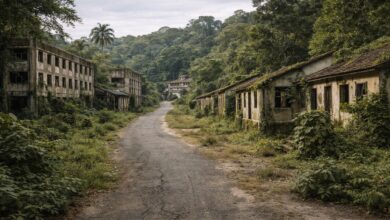
Deep within the rugged interior of Alaska, at the edge of Wrangell–St. Elias, the former mining settlement of Kennecott stands exposed to weather, time, and silence. Tall wooden mill buildings rise against mountains and glaciers. Houses, workshops, and support structures remain aligned along a narrow valley. Kennecott was not dismantled, burned, or erased. It was simply left when mining ended, leaving behind a town whose intact form makes absence tangible.
Kennecott’s impact comes from scale and preservation. The buildings still perform their original spatial roles, even though the activity they supported vanished decades ago. What remains is not ruin alone, but a complete industrial settlement without people.
A town built around extraction
Kennecott developed in the early twentieth century following the discovery of rich copper deposits. The operation was ambitious and technologically advanced for its time. Infrastructure was built quickly and decisively to extract, process, and transport ore from an extreme environment.
The town existed entirely to serve mining. Housing, power generation, processing mills, and transport systems formed a tightly integrated system. Similar human responses to silence and environment appear in settlement of Silver City.
Kennecott was not designed for flexibility. It was designed for purpose. What remains visible today is not only industrial architecture, but the scale of human ambition embedded in isolation.
Engineering against isolation
The remoteness of Kennecott demanded self sufficiency. Supplies arrived with difficulty. Winters were severe. Every structure reflected planning for endurance rather than comfort.
Buildings were substantial, engineered to withstand cold, wind, and snow. Their durability explains why they remain standing today.
The town was built to resist nature, not adapt to change.
Life structured by industry
Daily life in Kennecott followed industrial rhythm. Shifts dictated schedules. The mill dominated the skyline and the routine. Social spaces existed, but always in relation to work.
The town’s identity was inseparable from production.
When production stopped, identity collapsed.
Closure without catastrophe
Kennecott did not end because of disaster. Ore was exhausted. Operations became unprofitable. The decision to close was economic and final.
Workers left. Equipment was removed selectively. Essential infrastructure shut down.
The town emptied quickly, but not chaotically.
Buildings left in alignment
Unlike many abandoned settlements, Kennecott’s structures were not scattered or dismantled. The town remained organized.
Mill buildings still tower above the valley floor. Residences remain clustered nearby. Paths and access routes are still readable.
Order persists without function.
The mill as dominant presence
The massive mill complex remains Kennecott’s most defining feature. Its height and density communicate the intensity of activity that once filled it.
Industrial buildings often outlast residential ones because of their construction. Here, they also dominate memory.
The mill makes absence visible through scale.
Silence shaped by environment
Silence in Kennecott is amplified by geography. Snow absorbs sound. Wind moves across open slopes and through empty frames.
The town does not echo loudly. It feels sealed.
Silence becomes spatial rather than acoustic.
Why absence feels physical
Visitors often describe Kennecott as feeling heavy or pressing. This sensation comes from intact structure combined with emptiness.
Buildings still define movement. Rooms still suggest use. Without people, space feels unfinished.
Absence occupies volume.
Climate as conservator
Cold, dry conditions slowed decay. Wood weathered but remained stable. Metal rusted slowly.
Nature preserved rather than reclaimed.
Kennecott did not disappear into landscape. It remained exposed within it.
Infrastructure without users
Power facilities, rail alignments, and processing spaces remain legible. These systems were designed for coordination and flow.
Without users, they read as frozen diagrams.
The town appears paused mid operation.
Comparison with other mining towns
Many mining settlements declined gradually or were dismantled for materials. Kennecott’s closure was abrupt enough to preserve coherence.
Its remoteness discouraged repurposing.
Distance protected the town from reinvention.
Ethical restraint in interpretation
Kennecott is often framed as dramatic or eerie. Its reality is more grounded. It reflects the lifecycle of industrial ambition in extreme environments.
Responsible interpretation emphasizes labor, risk, and economic finality rather than myth.
The town needs no embellishment.
Memory embedded in scale
Because Kennecott’s buildings remain large and intact, memory attaches easily. One does not imagine small routines. One confronts industrial magnitude.
Scale amplifies reflection.
The town feels larger than its population ever was.
Time without adaptation
No new settlement replaced Kennecott. It did not evolve into another use.
Time passed without redesign.
Stasis defines its condition.
Presence shaped by design
Feelings of presence reported by visitors often reflect the town’s layout. Elevated buildings overlook paths. Windows face open ground.
Design implies observation.
Even empty, the town feels attentive.
A settlement that ended decisively
Kennecott did not linger in decline. When its purpose ended, it stopped.
The clarity of this ending sharpens its impact.
There is no ambiguity about why the town exists as it does.
Why Kennecott still matters
Kennecott matters because it demonstrates how industry can create complete communities that vanish when extraction ends. It shows the fragility of purpose driven settlements.
When function disappears, form remains.
That imbalance defines the site.
Between wilderness and industry
Kennecott sits within vast wilderness. Mountains and glaciers surround it. The contrast between industrial structure and natural scale is constant.
Nature did not destroy the town. It dwarfs it.
This contrast deepens awareness.
A place where silence is structural
In Kennecott, silence is not emptiness alone. It is built into the town’s preserved framework.
Walls, corridors, and towers hold quiet within them.
Silence has shape.
Enduring Perspective
Kennecott endures as a remote mining settlement left to weather and silence, where intact structures make absence physical rather than abstract. Its power lies in preservation without occupation. Buildings remain confident in form, even as purpose dissolved.
In the Alaskan interior, Kennecott stands as evidence that industrial ambition can create places too complete to vanish easily. When people leave, architecture continues to occupy space, holding the weight of what once moved through it. Here, absence is not imagined. It is built, measurable, and unmistakably present. Related reflections on memory and perception can also be found in mining town of Kadykchan.
Horizon Report documents places shaped by memory, infrastructure, and human decisions. Our editorial approach focuses on what remains physically visible, how abandonment unfolds over time, and how interpretation is clearly separated from observable evidence.
For readers seeking deeper context, the following background articles explore how ghost towns emerge, why communities are left behind, and why preservation matters in understanding collective history.
- Abandonment And Ghost Towns
- What Is A Ghost Town
- Why Towns Are Abandoned
- Preserving Abandoned Places
Editorial transparency matters. Observations are grounded in site layout, materials, remaining structures, and documented timelines where available. Interpretive layers are presented as interpretation, not assertion.
Careful readers often notice details worth refining. Thoughtful feedback helps ensure accuracy, clarity, and long term editorial integrity.